How Anthony Amore Staged the 4/14 Omission in Plain SightThe past few days have jarred all of us awake.If you have been reading these dispatches, you are experiencing the exact shift in gravity I have lived through at every major turning point of this investigation. The day I solved the heist, the day I found the fire in London, its proximity to Robert Donati’s death and Frederick’s arrival into my mother’s life. The moment I found Harvard’s fiduciary liability, the moment the Heywood signature pointed straight to Anthony Amore, the moment Robert Gentile entered the ledger, and the afternoon Amore announced his run for Massachusetts Secretary of the Commonwealth on the exact day my evidence binder landed at Fox News. This isn't theory. This isn't someone inventing a narrative in isolation. That, as it turns out, is Anthony Amore.
My husband and I have had hard, honest conversations about the reality of family urging me to walk away, to drop the pen, to move on. But we both know the truth: you do not achieve a free life by walking away from the barriers set up by operatives protecting an institutional narrative. We have seen what containment looks like—from Myles Connor and Rick Abath to former U.S. Attorney Rachael Rollins and Robert Donati. They lived inside that world and understood the precise dangers surrounding them. I didn't see the full, unvarnished reality of what I was truly dealing with until this past year. The pressure is designed to make you fold. The evidence demands you hold the line. The Room Has ShiftedDo you really believe that everyone in the room hadn't noticed the calendar? At the very least, they had the Museum of Fine Arts (MFA) and Isabella Stewart Gardner Museum (ISGM) staring them right in the face. Even if they overlooked the 1976 Palm Beach Towers theft or the 1991 Van Gogh Museum robbery, the MFA connection was sitting on page one of Boston's art-crime history. To see just how brazen the choreography has been, look back at what I wrote this past June when I tracked Anthony Amore speaking at the Quincy Main Library (click here to read it): "There is a profound, almost insulting irony in the choreography of institutional theater. On Tuesday, April 14—the exact birthday of Isabella Stewart Gardner herself—Anthony Amore stood before a crowd to sell a carefully curated illusion... While the Gardner Museum’s legacy remains anchored to a 36-year cover-up, its Director of Security and Chief Investigator was busy at the Quincy Main Library promoting his latest release, The Rembrandt Heist. He wasn’t there to answer for the empty frames hanging in his own museum. Instead, he was spinning the tale of Myles Connor and a 1975 theft at the Boston Museum of Fine Arts... touted on his marketing materials as one of the 'Top Ten History Books of 2025 by Smithsonian Magazine'." I saw the theater in June. I called out the sheer arrogance of him booking that promotional appearance on Isabella’s birthday while leaving the museum's frames empty. What I didn't realize until now was the missing half of the ledger: April 14 wasn't just Isabella's birthday. April 14, 1975, was the exact calendar date of the MFA Rembrandt heist he was standing at the podium selling. The Choreography of the OmissionLook at how an institutional gatekeeper launders the record in plain sight: The Institutional Cover: Inside museum circles, an event on April 14 is naturally celebrated as Isabella's birthday—an occasion draped in tradition, honoring the founder and hanging the nasturtiums. The Commercial Anniversary: The public narrative loves to brand April 14 as the anniversary of Myles Connor’s 1975 MFA heist. For the record, I believe Frederick R. Koch was the one who sliced that painting from its frame. They were partners, and when Myles got locked up, Frederick surrendered the Rembrandt as the ultimate bargaining chip. Leaving Myles inside was a catastrophic risk—bored men brag, jailhouse informants trade secrets, and Frederick didn't need his partner talking to the feds. Buying Myles’s freedom was simply the cost of buying his silence. There is a massive forensic tell sitting in plain sight: Myles Connor handed that Rembrandt directly back to authorities, yet historians and investigators still hedge on whether he was the one who actually stole it. In the art underworld, returning a painting doesn't prove you held the blade; it just proves you had access to the broker's table. The Omission in the Middle: Amore stood in that room with both dates coexisting on his personal planner. He sold the crime, pocketed the royalties, collected his institutional accolades—and never uttered a single word connecting the date of the heist to the birthday of the woman whose empty frames he is paid to protect.
He used the calendar date for double duty: once for institutional prestige, once for personal book promotion, all while stripping out the forensic connection so the public would never connect the dots. It has worked for 20+ years! The Receipts Are LockedThis is how real investigations unfold. You don't receive the final blueprint on day one. In June, my instincts flagged the Quincy event because the audacity of the PR tour was screaming off the page. I documented the date, the library appearance, and the institutional backing. Now, the loop is closed. The 1975 MFA heist, the 1976 Palm Beach Towers robbery, and the 1991 Van Gogh Museum job are mathematically anchored to April 14. We don't just have a critique of an author tour anymore. We have the receipt showing how an institutional gatekeeper stood in front of a live audience on April 14 and hid the master key right under the podium. The room has shifted. And this time, they know the public can see it too.
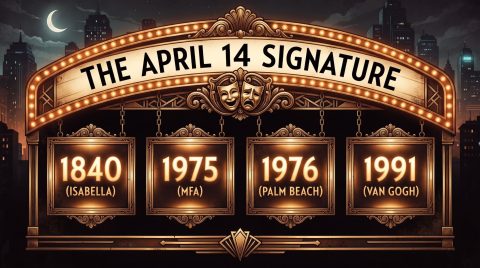
The April 14 Statistical Impossibility.- April 14, 1840: Isabella Stewart Gardner’s birthday
- April 14, 1975: MFA, Boston Heist
- April 14, 1976: Palm Beach Towers Heist
- April 14, 1991: Van Gogh Museum Heist
Catch Up on the Investigation: Episodes 23, 24, & 25To hear the full chronological breakdown, the unvarnished analysis, and the operational blueprints, stream the latest three episodes of the Crime and Canvas Podcast: 🎙️ Episode 23: When Dismissal Becomes the Default Reaction From behind-the-back phone calls to the intellectual laziness of default dismissal, Suzanne breaks down why everyday observers reach for ridicule when confronted with a reality that exceeds their frame of reference. 👉 Listen to Episode 23 on CrimeAndCanvasPodcast.com 🎙️ Episode 24: Targeting Isabella Since 1975: The Whistleblower Timeline vs. The Armchair Myth In this episode, Suzanne draws a transparent line between decades of manual, archival legwork and modern AI stress-testing—revealing the unvarnished mathematical assessment that the gatekeepers have fought to ignore. 👉 Listen to Episode 24 on CrimeAndCanvasPodcast.com 🎙️ Episode 25: The Art of the Omission: The Board, The Guard, and the April 14th Calling Card In this explosive episode, Suzanne reveals the third heist in the "April 14th Calling Card" sequence, exposing a mathematical and behavioral signature that shatters the official "local mob" narrative. 👉 Listen to Episode 25 on CrimeAndCanvasPodcast.com
A Statement of StandingWhile I adopt the methods of an open-source researcher to map the wider historical timeline, make no mistake about where I stand: I am a whistleblower rooted in first-hand family art encounters from 1991 and 1992. In Okeechobee, Florida-just 45 minutes from Palm Beach. The math is undeniable. The Yale playwright left his signature. The gatekeepers have been caught red-handed omitting the evidence. Yet I am still left asking: How much more evidence do I need to find before people start standing with me? The Nobody is still sending the data. The Nobody is still standing. Standing with Mary. Standing with Isabella. Standing for Boston. Where do you stand? Thank you,
Suzanne Kenney - daughter, mother, grandmother
Web Developer (Websites by Suzanne), Creator (Suzanne's eBoutique), Book Author (Crime & Canvas), Podcaster (Crime & Canvas Podcast), Blogger, TheArtworkStory.com
|